By Anna Stegeman
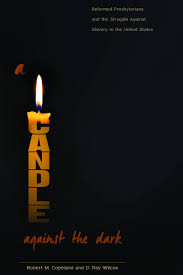
The fight against slavery in the Civil War era boasts many heroes–Abraham Lincoln, Harriet Tubman, Frederick Douglass, and many more brave men and women. But Robert M. Copeland and D. Ray Wilcox in their book A Candle Against the Dark, argue that one small group of people, largely forgotten in the pages of history, played a consequential part in the abolitionist movement. American Covenanters, especially the Reformed Presbyterian Church had “an outsized role in the crusade against American slavery.”
Copeland begins with the Covenanters background. They originated in Scotland where they suffered harsh persecution under the Stuarts during the early to mid 1600s which Copeland later points out might have helped them relate with the slaves enduring horrible treatment from their captors. When William of Orange overthrew the Stuart family the persecution relaxed and the Church of Scotland became Presbyterian. But as many of the Covenanters remained unhappy that the king still remained at the head of the church they immigrated to Ireland and America.
As Presbyterian ministers were scarce in the early American colonies two or three Covenanter families would form societies where every Lord’s Day they would meet together in a home for worship, discuss a Bible passage, talk about different Christian doctrines, and the like. But they refrained from holding communion or baptism in the absence of an ordained minister. As these societies grew into churches they organized themselves into the Reformed Presbytery in 1774 which eventually became “the Synod of the Reformed Presbyterian Church.”
In the War of Independence the Covenantors fought willingly. They saw it as a way to break free of the yoke that had been around their necks for centuries and envisioned America becoming a free Christian nation. They also expected that, among other new freedoms, slavery would be abolished. But the Reformed Presbyterians were disappointed as not only did the Constitution not abolish slavery but it also failed to acknowledge God as the source of the nation’s liberty which was central to the Covenanters political philosophy.
As the nation grew and tension increased around the issue of slavery the Reformed Presbyterians cracked down on those of their members who owned slaves. In 1800 the Presbytery “resolved to purge the church of this dreadful evil. They enacted that no slaveholder should be retained in their communion.”
Around this time a few Covenanters began to fight fervently against slavery. Thomas Donnelly, James Faris, and James Renwick Willson and many others strove to further the abolitionist movement through speaking against slavery, buying and freeing slaves themselves, and using the press to “unify their scattered communities and to attract others to their point of view.”
While the Reformed Presbyterian church was united against slavery–and they were one of the few churches who were–they could not agree on what course of action to take. Though most of them believed that slavery must be abolished immediately, some believed a passive witness was the best way to take; others advocated active opposition. For a little while the Covenanters promoted colonization, an attempt to return the slaves to their “home” in Africa where most of them had never lived, but when the church realized the majority of the slaves did not want to leave America and in some cases were forced to leave they withdrew their support and looked to another solution..
Most abolitionists believed that slavery was wrong but still thought whites were superior to the African Americans. The Reformed Presbyterians, however, thought differently and were one of the first churches to admit Black people into church membership on equal footing and sanction their marriages. Beyond the horrible cruelty the slaves endured, the Covenanters also saw it as detrimental to the free people too. For young men and women to understand that this sort of cruelty was okay coarsened their conscience. Slavery also discouraged industry among freedmen since they had slaves to do their work and to have to do your own work without the help of slaves signified poverty.
Then there was the most compelling reason against slavery for Christians–it is a sin and unbiblical. In Exodus 21:16 it says, “Whoever steals a man and sells him, and anyone found in possession of him, shall be put to death.” A person’s life is a gift from God and no one has a right to take it from them. It violates the equality of men expressed in Acts 17:26.
The underlying issue for the Covenanters was not only the injustice of slavery but the right to freedom. As said above they were one of the first not only fighting against slavery but also against racism. Just as slavery was a sin they also believed racism was a sin. Besides welcoming the Blacks into their churches, they also let them attend Geneva College, one of the first colleges to do so.
With a deep conviction that slavery was wrong and the slaves had the right to freedom the Covenanters readily risked their lives, economic security, and good name to help them escape through the underground railroad. Churches and houses were used as “stations” and many of them helped transport slaves to freedom. In Pennsylvania, Ohio, Indiana, Illinois, and other states, they were very active with the railroad. This humorous story illustrates it well.
A slave hunter entered a Covenanter family’s house as they were finishing breakfast, in search of slaves. Robert Speer, who operated a well-known station on the underground railroad, invited him to stay for breakfast and family worship. The slave hunter joined them and after Speer read a chapter of Scripture the family sang the entirety of Psalm 119 (all 176 verses), giving the slaves staying at their house that day plenty of time to escape.
As tension escalated over slavery and attempted solutions failed the United States fell into the Civil War. And the Covenanters joined the ranks of the North in substantial numbers. They fought this war “in the interest of slavery against the United States.” Rev. Todd led a company of volunteers that included thirty-one men from his own congregation. Seventeen members of a Pennsylvania congregation enlisted. Sixty-nine Geneva College students and alumni served. Among their ranks were surgeons, chaplains, majors, captains, generals, and lieutenants. Twelve were killed in action. After the war, however, it proved impossible to tally the total number of all the Covenanters who fought in the war.
The Covenanters were one of the few who had a vision beyond winning the war. Helping the freed slaves was a major concern for them, especially educating them. Since Southern teachers refused to teach Black students, Reformed Presbyterians along with many others ministered to the Blacks in the South, establishing schools, houses, and missions work. They also prioritized training Black ministers so that they could in turn teach other freedmen. In a time when much of the aid given to the Blacks was chaotic and inefficient, the Covenanters’ work to help the Blacks even after they were free was substantial. They established an industrial school to teach the freedman trades so they could find jobs.
This small group of dissenters were one of the few groups who remained united against slavery and saw not only slavery as wrong but racism too. Copeland does a great job of taking you through the history of the Covenanters and their fight against slavery. It unveiled for me a part of history that I have studied a lot but never heard about the Covenanters’ role in it. And what an impact they did have, especially in contrast to their numbers.
I definitely recommend A Candle Against the Dark, especially for those who enjoy history or reading about forgotten stories that had a big impact. It’s a fascinating read that chronicles the incredible history about a group of people whose role in the fight against slavery has largely been forgotten.
For more on this subject, click here.


I never knew anything about this group, very interesting! Thanks for the information Anna.
LikeLike
Thanks Aunt Jo!
LikeLike